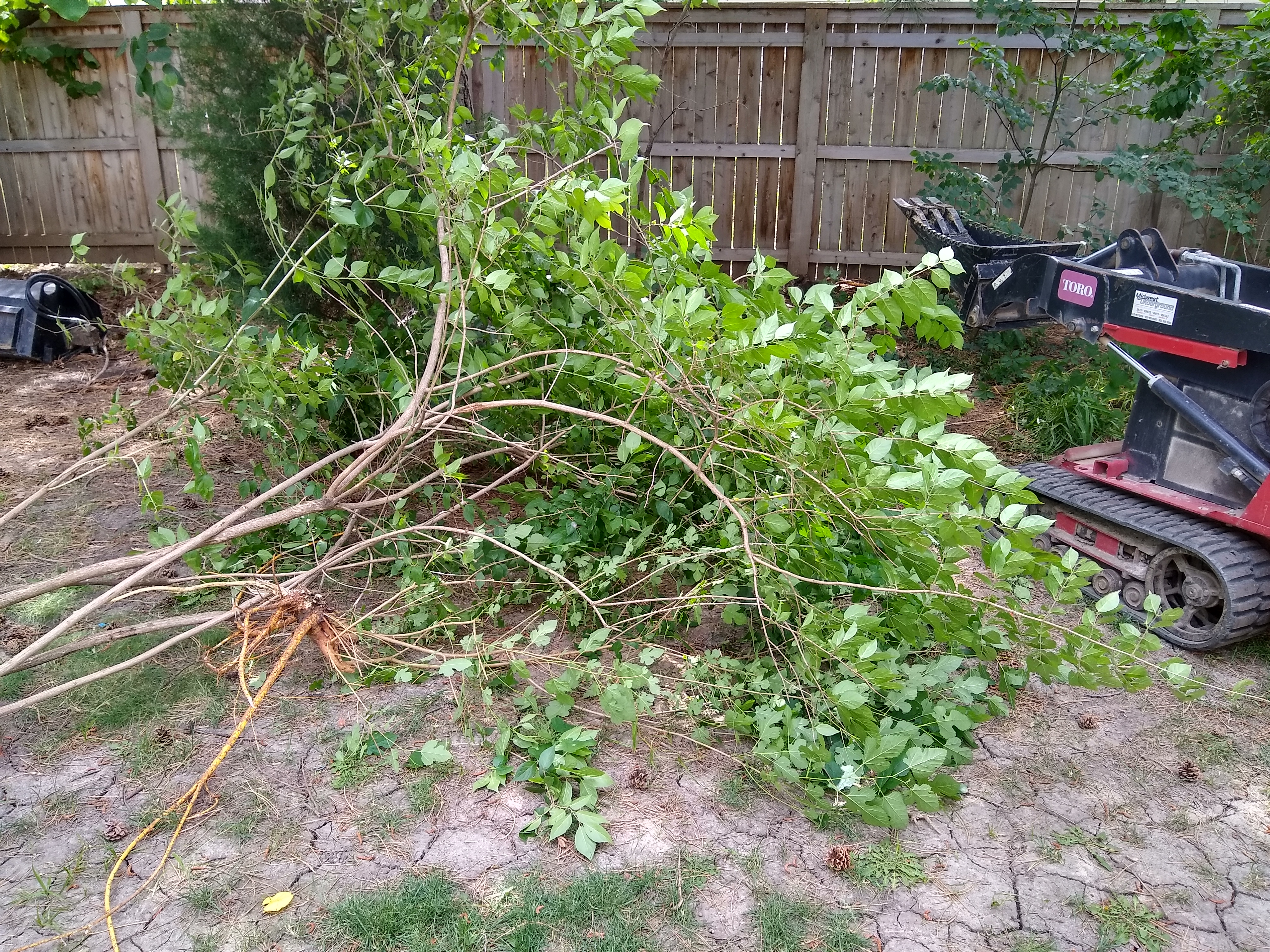
Young bare root fruit trees are some of the lowest cost trees you can purchase.
Wednesday, January 17, 2024
Custom Grafted Apple Trees
Friday, January 12, 2024
Gardens vs Tree Roots
![]() |
| Durable block wall raised beds with... Under Armor !?!? |
These garden beds, installed this summer, were going in near an existing Hackberry tree. Although near the current drip line, the footprint was small, and the installation shouldn't damage its roots any more than the other construction traffic.
However, future growth would mean that the root system would be expanding. I was concerned about these tree roots invading the raised beds and stealing water and nutrients from the plants growing there.
![]() |
| Original SPROUT Garden |
When we reclaimed the wood to use in the new project, we found that the remaining soil was almost a solid "loaf" of tree roots!
I've have also dealt with them in my own garden as well. Maple trees love to send out exploring feeder roots!
- We added heavy fabric to keep the rock separated from the existing soil.
- Then we added a 2-4" layer of river rock, to keep air pockets open.
- Before filling the beds with soil, another layer of fabric was added.
![]() |
| Trellises were added for some vertical growing space. |
Thursday, January 4, 2024
No Mow - New Construction
![]() |
| Front yard #Before |
![]() |
| Front yard - planted and mulched |
![]() |
| Prairie with rain garden view from the deck |
![]() |
| Solarizing 8000sf of yard |
Around September, we removed the plastic sheeting and planted an oat cover crop to hold soil and keep weeds at bay. Prior to the cover crop seeding, we pulled and flamed the remaining weeds that took advantage of tears in the plastic caused by curious deer.
Thursday, December 14, 2023
Abundant Design Holiday Gifts
This year you might considering an alternative gift. We'd like to offer some ideas and options that are earth-friendly and fun!
These gifts will be available for pickup mid to late spring, but you can get a printable certificate for gifting.
Pollinator Plug 6-Pack $30
6 pack of native plugs, wildflowers only Order a 6-Pack
- 6 larger potted plants for $60
Pocket Prairie Starter $45
15 Native prairie plugs, include wildflowers and grasses for diversity. These plants are suitable for a 4' x 8' or similar sized planting area and include shorter species for the front and taller growers for the back.
- 15 larger potted plants $150

Tree Guild To-Go $50
perennial & productive
Newly grafted fruit tree along with companion plants; 2 chive plugs, 2 white clover plugs/seed packet, comfrey root cutting
- Upgrade to 4-6' potted tree +$50
- Add strawberries, 5 large crowns +$5
-Newly grafted fruit tree only for $25
These Holiday Deals will go through the end of the year. Installation is also available for next season.
Sometimes the butterflies, bees and hummingbirds can hardly wait for our plants to get in the ground!
Tuesday, November 21, 2023
Rain Garden Design & Installation Video
![]() |
| Patchy lawn #Before |
![]() |
| Reworked sizing for split basins |
![]() |
| Laying out plants |
![]() |
| Fresh Rain Garden Install #After |
Wednesday, November 1, 2023
Invasive Species
Most people are familiar with Bush Honeysuckle (Amur & Tartarian), one of the worst offenders across the Midwest. Its lifecycle helps it outcompete native shrubs because it keeps it leaves longer in the fall getting just a little more energy and time to grow. It forms dense, shrubby, understory colonies that eliminate native woody and herbaceous plants. The berries are not edible for people, but birds readily eat them distributing seed everywhere. Look for seedlings under trees and overhead utility wires and by fences. Initially introduced as an ornamental, its planting was even formerly encouraged along fence rows to prevent erosion and for wildlife habitat. ![]() |
| Trevor displays his honeysuckle trophy |
![]() |
| Barberry is a nasty one, with painful and irritating thorns |
![]() |
| Barberry at Browns Woods in West Des Moines |
![]() |
| Brilliant, but Invasive, Burning Bush |
Wednesday, July 5, 2023
Keeping Rootstocks in Check
![]() |
| Suckers growing from the rootstock |
Grafting lets us know which variety of fruit we are growing, assuring we get our favorite flavors and other qualities. This top part is known as the Scion wood and is grafted onto a known rootstock.
The Rootstock is the part of the tree that will grow in the ground, and also chosen for its characteristics. Rootstocks can be seedling grown for economics but are typically cloned with reproducibly known qualities. These may be chosen for size, disease resistance or performance in a specific soil type.
While trees are young, "root suckers" and other branches on aggressive rootstocks have an easier time growing as the graft scar takes some time to heal completely. This reduces nutrient and water transfer, hindering the scion's ability to grow until it heals completely. These branches and suckers can sometimes grow rapidly and overtake the slower grafted portion. If left unchecked this can eventually cause the grafted part to atrophy and die, losing your chosen variety.
In the video we'll visit the Food Forest at Drake University to demonstrate sucker pruning on a young grafted American Persimmon tree.
Branching and suckering of the rootstock is one way to lose your grafted variety from trees and you will be left with lesser quality fruit, if any fruit at all. Removing these vigorous suckers is necessary for the long-term health and productivity of the tree.