Sunday, August 31, 2014

Lemongrass - A Tropical Herb in a Midwest Garden

This weeks post brings a visitor from the tropics - Lemongrass
There are many uses for Lemongrass from insect spray to teas.  In the following video I will tell all about how to grow it here in Iowa, what it has been used for medicinally, and how to make a tasty lemon tasting herbal tea.
I hope you enjoy the video as much as I did making it.
Leave me a comment and let me know what you thought, or give me some ideas for future topics that you would be interested in learning more about!


By the way, here is the link to the Lemongrass-Cholesterol study
http://www.researchgate.net/publication/20570442_Impact_of_lemongrass_oil_an_essential_oil_on_serum_cholesterol

Sunday, August 24, 2014

Plantain - Underappreciated Plants & "Weeds"

What is a weed? A plant whose virtues have never been discovered. - Ralph Waldo Emerson
 
Sadly, many plants get labeled as weeds regardless of where they grow; especially in our population that loves a manicured lawn or crop field.

According to Merriam-Webster.com the definition of a weed is:  a plant that is not valued where it is growing and is usually of vigorous growth; especially :  one that tends to overgrow or choke out more desirable plants

So, the location of growth is a true factor in the label of weed.

Today our focus is on Plantain (or Plantago Major, not the starchy banana you see at the supermarket).  At one time I would pull this from my lawn or spray it with some toxic blend of  2,4-D, mecoprop or dicamba.  Times have changed, and with a little knowledge, I have come to LOVE this diminutive perennial plant and all it can do!

Watch this video where I tell you all about it!  Leave me a comment, it'll make my day!
 

Saturday, August 16, 2014

Turning Compost to Speed Up the Process and Avoid Problems

This week the focus is back on compost!

Composting your plant based kitchen scraps and yard waste is a great way to reduce your contribution to our landfills.  Compost builds soil structure and organic matter that will help it retain water and feed the organisms that are part of healthy soils.  Healthy soils mean healthy plants, whether they are vegetables, trees or grass. 

In this video I will show you the order I flip my bins, the stages of decomposition, hints, and how to avoid problems.  Remember to mix your materials well, as demonstrated, and keep it moist, not wet, for the best results.
Now is the time to be building your pile up so they have enough mass to carry on the process in the middle through the winter.  If you would like a composting system, raised beds or a forest garden for your home, contact me and we can get you started!
 
It looks better if you click the link to watch directly on YouTube.  I will try to fix this better next time.  Leave a comment or ask any questions below!

Friday, August 8, 2014

Pesticide Free Japanese Beetle Defense


Looking for a mate or a meal in the corn patch
They're Here...
As I walked through my yard tonight I found them. 
I had heard others talking about them, but had only seen one or two so far this year.  Now they are in my backyard.  Two years ago I had tons of them and they did quite a number on my apple trees,
and seriously denuded our cherry.  Last year I
was pretty vigilant, but they didn't seem as bad.  Only time will tell for this year...


Japanese Beetle on a Peach Tree Leaf


What are they?
Japanese Beetles are an iridescent copper and green colored beetle, about 1/2" long.  They would be quite beautiful if they weren't quite so destructive.  They eat the leaves of your plants, leaving the skeletonized veins behind.  This kills the leaf and hinders its ability to perform photosynthesis (using the sun's energy to make sugar, energy for the plant).

Controlling Them
Adult beetles are difficult to control.  There are certain nematodes and bacterial products that over time can control the larvae in your yard.  The problem is the ones eating your plants may not be from your yard.  The Japanese Beetle has an acute sense of smell and can be attracted from long distances in its search for a mate.  There are also traps that use these pheromones to attract and trap them.  I have not tried these because I don't want to attract any more than I already have, and from what I've read that is what they do. 


Fresh tonight, not stinky yet
What works best for me is to add some dishsoap and water to an ice cream bucket.  The bucket is large enough to catch them in, and the soapy water coats them with a film that they cannot breathe through.  The beetles are poor flyers and usually drop from the leaves when disturbed.  I take the bucket, hold it under a leaf or group of leaves with the biggest collection of beetles, and give it a shake.  The stubborn ones may need a finger flick to be convinced to take a swim.  Be careful not to shake the branch too much or the others on the tree/plant may fly away before you get them.  This seems to be a good way to catch large bunches of them. 

But here's where it gets sort of gross.  I figured since they are so attracted to the smell of living ones, would they be repelled from the smell of dead and rotting ones?  The idea may have come to me because I once left a bucket for a few days in the garden with dead ones in it.  Leaving the stinky bucket near plants that are the Japanese Beetles' favorites has seemed to keep them away!  I have also tried to protect several trees, by dipping some of the mass of dead beetles out of the bucket and around the base of the trees I want to protect.

Maybe it should be higher?


Integrated Pest Management
I also put up a wren house this year that I built out of some scrap lumber.    Plans can be found many places on the internet.  I modified these to be able to use what I had for leftover wood.  I have heard of these little songbirds being quite fond of the pesky beetles.  Unfortunately, we didn't get any to nest in it this year, maybe next year.


More Tips
Also if you are planning new landscape plantings here is a list of plants the are favorite foods and not so favorite foods of our pretty little pests.
Courtesy of http://www.ipm.iastate.edu/ipm/hortnews/2010/7-14/japanesebeetle.html 
Least Favored By Japanese BeetlesMost Favored by Japanese beetles
Arbovitae
Boxelder
Boxwood
Clematis
Dogwood*
Euonymus sp. (burning bush, etc.)
Forsythia
Hemlock
Hickory
Holly
Juniper
Lilac
Magnolia
Mulberry
Northern red oak
Pine**
Red and silver maples
Redbud
Spruce***
Sweet gum
Tulip poplar (tuliptree)
Yew           
American and English elm
Birch
Black walnut
Elm
Grape
Hawthorn
Hollyhock
Horse-chestnut
Japanese* and Norway maple
Larch
Linden
London planetree
Malus spp. (crabapple, apple etc.)
Mountain ash*
Pin oak*
Prunus spp. (flowering cherry, etc.)
Pussy willow
Rose
Raspberry
Virginia creeper
Willow
  * May not be hardy or perform well throughout Iowa.
** Scots and Austrian Pine are not recommended because of disease problems.
*** We do not recommend blue spruce because of disease problems
 

Saturday, August 2, 2014

Speed up the composting process

Sorry for the delay for this weekend's update.  More coming soon...
 
For now, here's a brief video how to speed up the decomposition process from my friend Matthew's YouTube Channel.

Friday, July 25, 2014

How to Build a 3-bin Compost System

Improve your soil structure and increase the biodiversity of your soil by making compost.  This week's post includes a video how you can make your own composter.

Use these bins to discard your fruit & vegetable scraps, egg shells and yard waste and keep it from taking up space at the landfill.  Turn the pile often for good aeration and mixing to speed up the process.  Composted organic matter helps your yard and garden soil remain loose and workable.  Earthworms are drawn to it and leave behind castings that are a valuable fertilizer prized by organic growers.

There are many ways to compost your organic waste from just a pile or wire bin to a barrel system with trapdoors and rollers; but these nice looking cedar bins will look great and fit well in any neighborhood backyard.

Friday, July 18, 2014

Rain Barrels are great, but...

 
"...they're not growing their own food. Like the 55 gallon rain barrel, they deceive themselves by thinking that by toying with inadequately designed rainwater collection systems...
 
Thirty five thousand gallons of rain falls off my roof but I want to hold fast to the cute idea that a little 55 gallon barrel will hold it all and I can feel like I've saved the world. That’s simply poor design and living through your concepts rather than your observations." 


While not all of us can have a 100+ acre Permaculture farm that utilizes the landscape to harvest rain water, we can gain some insight from Mark's comments.  When you consider the amount of rain we typically get in central Iowa and the surface area of our roofs, you realize that we cannot hope to contain it all in one, or even several, 55 or 75 gallon rain barrels (see calculator).  Ideally you would have several modified 275gal. Intermediate Bulk Containers (IBCs) which can be an eyesore if not properly disguised and take up a large footprint.
 
What we can do to bridge the gap in our urban/suburban rain water harvesting systems is to utilize the rain barrel as storage for use in our potted plants, etc. that we want to benefit from using rain water over the municipal water supply. More importantly, though, we want to manage the overflow so we can use the rain to maintain soil moisture for longer periods of time. 
 
There are several ways we can Divert, Disperse & Conserve the overflow to our planting areas:
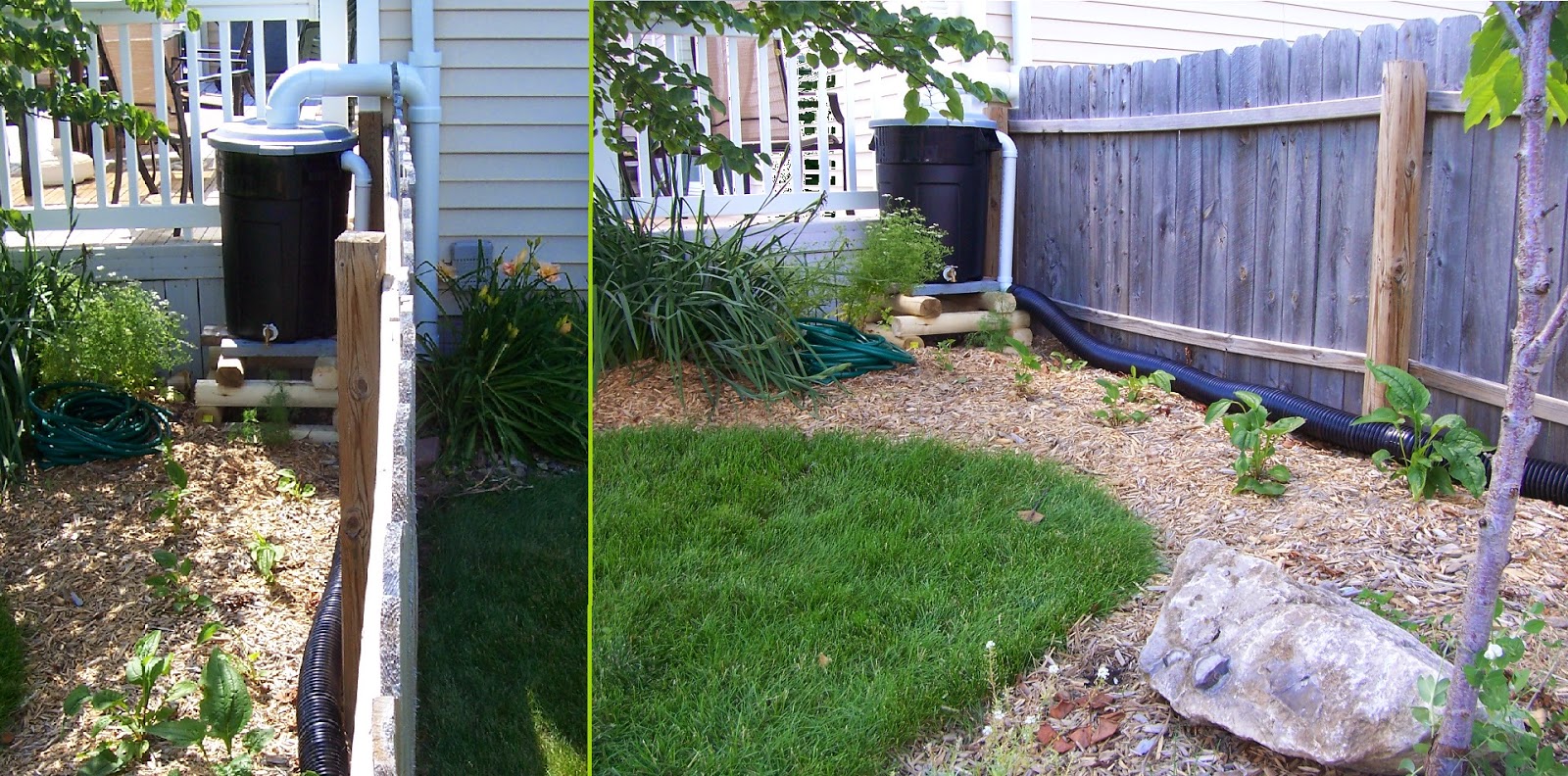
  • This picture below is of my prototype rain catchment system.  It utilizes a smaller barrel and simple overflow into 4" drainage tile (8' solid to get away from the foundation, then 16' perforated to allow the overflow to slowly drain into our mini-forest garden. 
 
  • This next system utilizes a more intricate overflow irrigation system.  The overflow drained into a series of PVC pipes that were set-up with multiple junctions, runs and 1/4" drainage holes that allowed the overflow to go to targeted areas of the planting.  The tricky part was running a split under the walking path and back up into the "island".  Make sure your system completely drains all water so the lines will not freeze and burst in winter.

Before hiding the barrel behind a trellis

Dividing the overflow to multiple areas

The lower levels prior to covering PVC with straw 
  •  Another way to enhance water retention is through mulching.  Mulching keeps direct sunlight from heating and drying the soil.  It also holds a layer of moist air that won't blow away in drying breezes and steal moisture away. 
  • "Swales on Contour" will also slow runoff and allow it to sink into the soil.  Typically swales in modern construction flow with the slope of the land to route rainfall quickly to drainage ditches, rivers and streams.  Two days after a rain suburban homeowners are out with the sprinklers trying to keep the grass green.  With swales on contour, the "ditch" runs across the slope where the runoff slows, giving it time to percolate into the soil.
I hope this post gives you ideas for ways you can go beyond the rain barrel.  If you have any questions feel free to post in the comments section below.  Or if you would like to have a rain catchment system installed at your home send me an email!

Thanks for stopping by and reading my blog,
Jeff