Sunday, September 27, 2015

Western Hills Family Retreat

Although still used, this raised fire pit space was overgrown and really needed tidying up.  The soil was compacted, and weeds were the only thing growing in this highly compacted area.  The homeowner was tired of fighting the weeds and wanted something done. 
 
 
Plans were put in place for a new fire pit and patio area, with new boulders and a potential planting on the back edge.  As the project plan developed, the decision was made to create a patio comprising the whole raised area and a separate raised bed with a mini-orchard and forest garden.  Already avid gardeners, they really liked the concept.

Other ideas-
  • The carpetball game table is a family and guest favorite, so access and spectator space was key.
  • Include Hydrangeas!

The hostas and daylilies were relocated to the back side of the privacy fence where there was a need to slow water flow, reducing erosion and filtering runoff, coming off of a parking lot.  Hardy plants, they survived transplanting even in mid-summer thanks to quick work and forgiving afternoon shade.

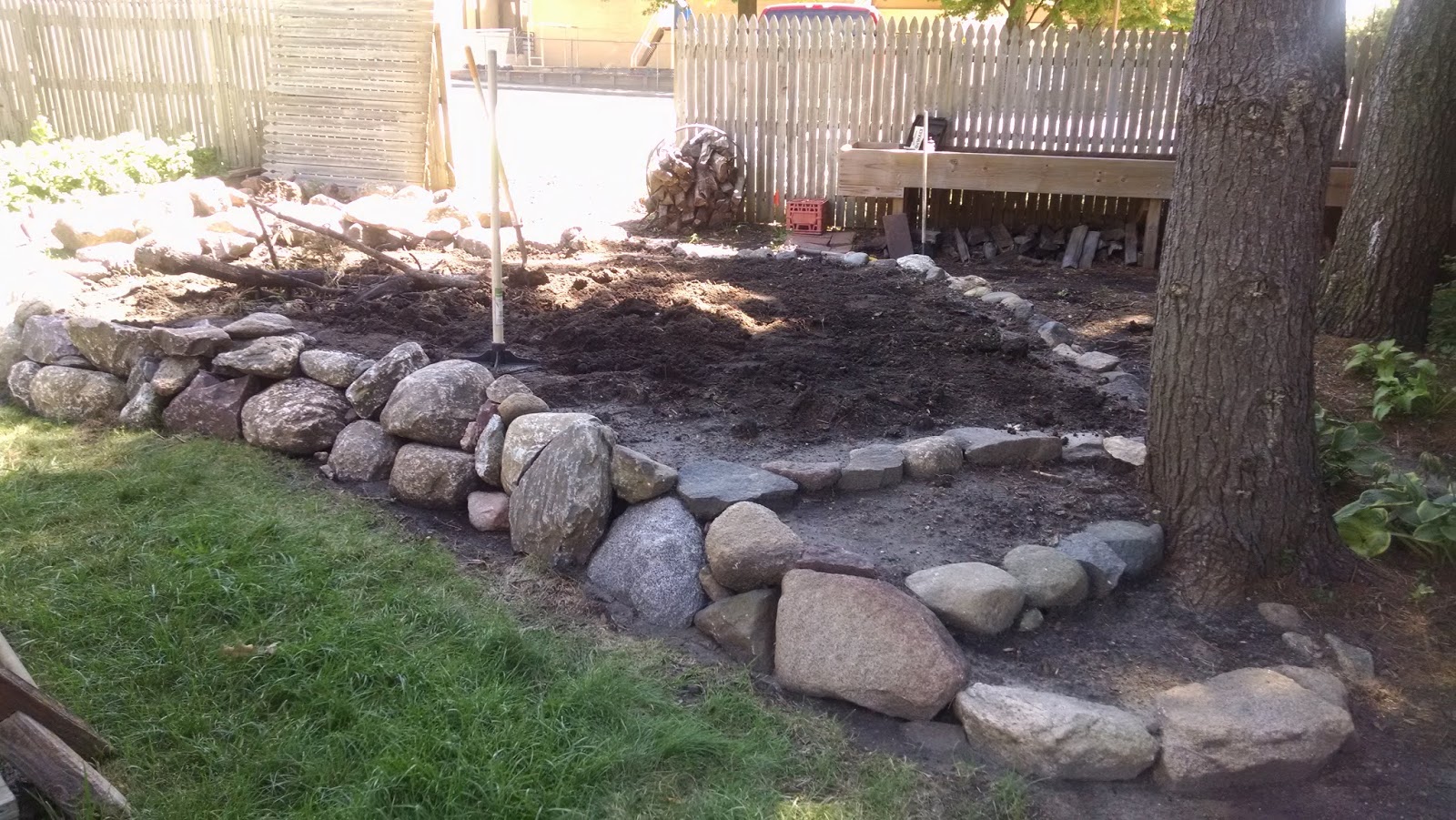
The fire ring of small boulders was removed and the existing walls were torn down.  A new base was dug and compacted.  Serendipitously a stairway formed at the junction of yard, path and patio.


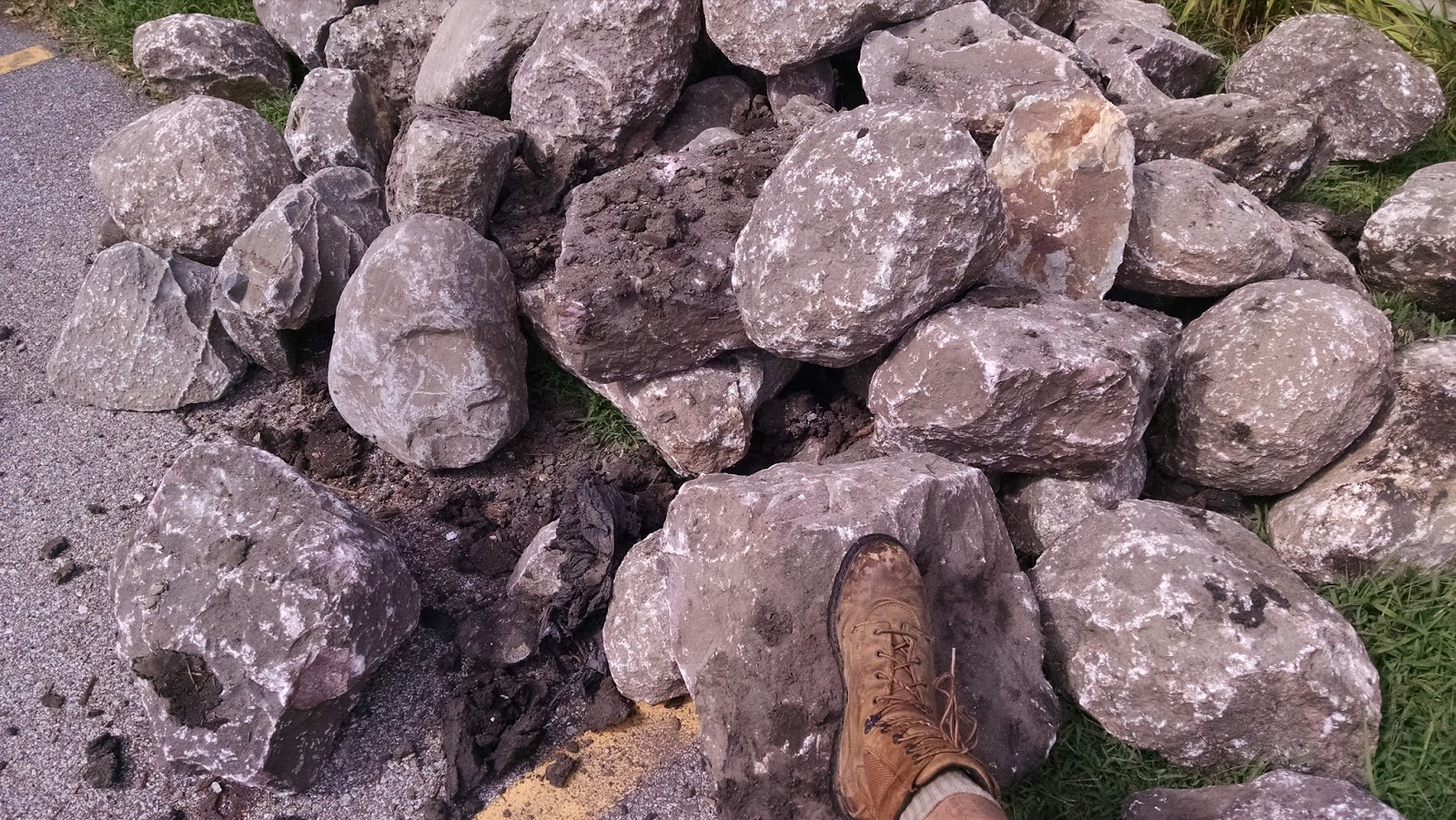
Several tons of boulders were brought in to finish the retaining walls and establish the raised beds for the fruit tree guild.  The entire surface was tamped to stabilize the soil disturbed by constructing the retaining walls.  Next, the paver base material was laid and packed.


For the fire pit to match the look of the patio, I cut bluestone edging to build the custom outer wall, and a heavy duty fire ring lined the inside.


Large bluestone pavers were laid in position, arranged and rearranged for the best fit.  Once a few corners were removed for a tighter fit and the best layout was determined, they were leveled with sand and set in place.


The river rock and stepping stone pathways took inspiration from dry stream beds in the new rock valley.  The path was graded and covered with cardboard "sheet mulch" to kill any remaining weeds prior to laying the river rock and bluestone steppers.


The forest garden bed was seeded with cover crops including radish, wheat and clover to sustain beneficial soil life until apples, strawberries and more were available.  A few modifications were made to the original sketch to accommodate plant availability and future plans.


Horseradish was included in the background for contrasting large leafy texture as well as to be used as a nutrient rich mulch when cut. Clover was included for nitrogen fixing =natural fertilizer.  We also planted a mix of flowers, including prairie natives, to attract pollinators.

Hydrangeas, as well as an additional American Cranberry, were spaced on the right side of the path to enhance the remaining hostas and bleeding hearts.
 
 
If you enjoyed this project, contact me and we can make a plan for your backyard edible oasis! 
 
Have a great week!


Saturday, September 19, 2015

5 Seeds YOU can Save

Saving seeds is a skill that many backyard gardeners are scared to try because it seems intimidating. 

These simple tips will take you to the next level of gardening, with a sense of accomplishment from planting seeds next year that you've collected yourself. 


A few things to keep in mind before starting will make the most of your efforts.
  • Start with open-pollinated, inbred or "heirloom" varieties.  These varieties have been bred so that characteristics are similar from generation to generation.  Hybrid lines have different parent lines for vigorous growth or fruiting, but subsequent offspring will not usually have the same successful genetics.
  • Separation between different varieties of the same crop or family is necessary to maintain the genetics from the parent into the offspring.  This can be done by distance, planting different varieties as far apart as possible.  Some pollen can travel farther than practical for typical backyard gardeners to separate.  In this case physical barriers may be necessary; shoot and tassel bags for corn, is one example.
  • Choose fruit or seed from the healthiest, most desirable plants.  Avoid plants that have more signs of disease.  Take seeds from the plant with the largest, reddest or tastiest tomatoes; or ones that ripen earliest or latest.  Over time you may develop your own heirloom variety that works best for your property.
If you have the space, and patience, and an experimental curiosity you can try mixing varieties to try for the best of both lines or come up with something entirely new!

The plants in the video below are perfect ones to begin your seed saving adventure. 


Sure it can be easy to go down to the garden center, hardware store or even Wal-Mart.  But what if they are out of a vegetable you want?  Or worse, what if you have found a delicious variety that grew very well for you and they are out of that certain one?  If your favorite is an "heirloom" or open-pollinated variety it is a perfect candidate for seed saving.  Seed saving will also save you some money each year, depending on your scale. 

Last Spring Abundant Design hosted a community seed exchange at the YMCA.  There was plenty to go around, extra to donate at the end, and the best part was the conversations and connections made with local gardeners, orchardists and CSAs (Community Supported Agriculture).  If you are in the area, I'd love to see you at the next one!

For more information and seed saving supplies visit Seed Savers Exchange.  Here is a link to their  Products Page.


Have a great week, autumnal equinox and first day of Fall!


Saturday, September 12, 2015

"S" is for September, and Safety

I had a great week this week! 

Took Friday "off" and helped Ralph and a group from AmeriCorps put in the support posts for the fruiting walls at the Forest Avenue Outreach Community Orchard. Most of the trees planted earlier this year look great!
  ...and I got to enjoy a pear from the existing tree there. Yum!


I also got some of the final plants put in on a project.  A couple more waiting to arrive from the nursery and we'll be ready to grow.

Around my home, I collected some seed, potted up some plants in the nursery and let the kids pick some pie pumpkins and carrots.  I also found some great deals on end of year stock that I got planted in the yard as well. 

All in all, a great start to September!


A couple things did happen that made me think though, and I feel I should share.  While finishing up at the orchard, most things were packed away, the conversation went like this. 

     "Well, I'm glad we didn't need the first-aid kit!"

     "Me too, I'm always worried about that..."

A couple minutes later I was driving a nail on the support to hold the post in place for the concrete to set, and WHAM!  I got my finger with the hammer.  Smarted.  But I finished the nail, and realized  that I was bleeding pretty good.  There may have been a gasp or two from the by standers.

Getting better after a day
As a band aid and some extra tape were applied...

     "We had just said, 'glad we didn't need the first aid kit!'"

     "Yeah, I know..."

With my dry skin from not always wearing my gloves, it laid it open pretty good.  But I heal pretty quick.


It's a good thing, too. 

While finishing up the project planting, I was trying to get done so I could get home by a certain time.  I got in a hurry and a little sloppy.  My foot slipped off the top of the spade and the corner bit me in the arch of my foot.  Not a big deal, but the tenderness probably slowed me down more than if I hadn't hurried and I did get a decent bruise out of the deal.


So, this week's blog post is about Safety - being aware of the things that can go wrong and minimizing the risks.  Mine were minor but with harvest season coming up and lots of Fall chores around the yard and garden, it's a good time for a reminder.

Some of the best ways to avoid injuries are:
  • paying attention to the task at hand
  • staying out of the "line of fire"
  • use the right tool for the job
  • wear correct protective gear or apparel
My example of being in a hurry caused me to slip, hurting my foot.  I was focused on the time and not being careful.  Other examples include distracted driving by texting or talking on a cell phone.  Already a proven deadly practice, these can be even more so with the addition of slow moving farm equipment on the roads.  When using farm equipment be sure to watch for overhead power lines, exposed PTOs and other operators.

"Line of Fire" describes the path of a flying tool or part in the event of an accident or mechanical failure.  Make sure all equipment guards are in place; never try to bypass the mechanism.  Stopping a lawn mower, if a child or pedestrian is near so that if an unknown rock or other object cannot become a missile and injure them.  Watching out for your knuckles when twisting a wrench on a stuck bolt or nut.  A good rule of thumb is always cutting away from your body with a knife.  Being aware of what's beyond your target when shooting and hunting, is another example.

Always using the right tool for the job will go a long way in keeping you safe.  Tools are designed for a purpose, and at times we may be tempted to stretch it beyond what it was designed for.  Screwdrivers are not chisels.  Pennies are not fuses.  I've seen scissors used countless times in place of screwdrivers, chisels or prying tools.  One slip and here comes the pain. 

Protective gear and apparel could be a post unto themselves, but here are some of the top things I think you should use. 
  • Gloves are a great example of protective gear.  Cheap cotton ones can keep your hands from getting blisters while raking, shoveling or hammering.  Leather ones give you more protection against abrasions or sharp thorns and twigs. 
  • Good boots can protect your feet from injury.  High ones can prevent you from twisting ankles, and steel toes can protect feet from heavy or dropped objects.  A steel shank could have helped the arch of my foot when it slipped off the shovel. 
  • Safety glasses are probably the most important piece of protective gear you can wear.  Eyes won't heal they way skin or even bone can.  And the smallest of flying fragments can ruin your workday or worse, cause major damage including blindness.
  • There are many, many other protective items that should be used based on the situation:
    • Hearing protection
    • Dust masks and respirators
    • Rubber gloves
    • Goggles or Face shields
    • Hardhat or Helmet
    • Chainsaw chaps or aprons
    • and more

These gloves need replaced after turning that pile of rocks into a retaining wall

So, be careful out there!  Stay safe and healthy this Fall season so we can enjoy the Winter and do this adventure again next Spring!

Thanks for stopping by, and have a GREAT week!!!


Monday, September 7, 2015

Happy Labor Day!

Happy Labor Day!  I hope you are enjoying time off today or at least making an easier day with only the necessary chores. 

I also have been taking time with my family this weekend and won't have a new post, so I'll leave you with a link to a post I wrote last year about this time.

Although we spent a day at the water park and not at the arboretum,  I love the quote by Edward Abbey at the end.
 
Have a great week and watch for a new post next week and more new videos this Fall!

Sunday, August 30, 2015

Operation: Toad - A Rescue Mission

Thought you were lost...
After our walk the other night, I checked on the caterpillars and the gardens.

It was such a nice evening. For some reason I glanced into the hole where our scarecrow had once been and saw movement.

What is this?!?!


On closer inspection I saw a white throat swallow and a quiet squeak rose from the hole.

A toad!  How did he get in there?

I've rescued many from our window wells but this seemed like a pretty small hole to get stuck in.  He must've stumbled in just perfectly backwards.

Being careful not to bury him, I moved some soil from around the opening. Then I got the potato fork and gently popped the hole and surrounding dirt from the ground freeing him.

I almost stepped on its little brother/sister/friend in the process...

Freedom!


Little brother?
OK guys, you're free!  
                   Go eat some bugs!!! 
 
 
This large fellow we discovered today sure has been eating well.  About the size of a tennis ball, he ate several ants while we watched!

Did someone say 'eat some bugs'?


Sunday, August 23, 2015

Favorite Gardening Quotes

Crazy weekend here with my truck in the shop, sick dog as well as the typical weekend activities and chores I tried to get done.
 

Here is a quick video of a quiet moment I stole to watch the swallowtail larvae eating.  They sure are growing, and eating so much.  I hope there will be plenty of food for them to grow large enough to pupate!
 
 
Also here is a list of some of my favorite gardening and farming quotes I've saved over time.  Enjoy!
 
"No occupation is so delightful to me as the culture of the earth, and no culture comparable to that of the garden. I am still devoted to the garden. But though an old man, I am but a young gardener." Thomas Jefferson in a letter to Charles Wilson Peale

George Washington wrote, "...to be a cultivator of land has been my favorite amusement."

There are two spiritual dangers in not owning a farm. One is the danger of supposing that breakfast comes from the grocery, and the other that heat comes from the furnace. ~Aldo Leopold

 The one small garden of a free gardener was all his need and due, not a garden swollen to a realm; his own hands to use, not the hands of others to command." - J.R.R. Tolkien,The Lord of the Rings, Sam Gamgee

To forget how to dig the earth and to tend the soil is to forget ourselves. ~Mahatma Gandhi

A garden is a delight to the eye and a solace for the soul. - Sadi

Gardening is the purest of human pleasures. - Francis Bacon

Creating your own urban farm is as simple as planting your flowerbeds with edibles. ~Greg Peterson, My Ordinary Extraordinary Yard: The Story of the Urban Farm, 2009

It is a golden maxim to cultivate the garden for the nose, and the eyes will take care of themselves. ~Robert Louis Stevenson

When I go into the garden with a spade, and dig a bed, I feel such an exhilaration and health that I discover that I have been defrauding myself all this time in letting others do for me what I should have done with my own hands. ~Ralph Waldo Emerson

Gardening is civil and social, but it wants the vigor and freedom of the forest and the outlaw. ~Henry David Thoreau

Gardening is a way of showing that you believe in tomorrow. - Author Unknown

Gardening is medicine that does not need a prescription ... And with no limit on dosage. - Author unknown

Gardening is cheaper than therapy and you get tomatoes. -Author Unknown

Essential advice for the gardener: grow peas of mind, lettuce be thankful, squash selfishness, turnip to help thy neighbor, and always make thyme for loved ones. ~Author Unknown
Gardening is the most therapeutic and defiant act you can do.  Plus you get strawberries!  -Ron Finley

Life begins the day you start a garden. ~Chinese Proverb
 
 
On your mark,
                         get set,
                                        GO!

Sunday, August 16, 2015

Rain Barrel Recharge


Good day to empty rain barrels!

Short post this week but I wanted to get it out before we ran out of daylight if you're in the central Iowa area.  That way you'll have time to empty those rain barrels with your super powered rainwater into your planting areas or even lawns.


Although we've had a pretty wet year so far we have had a stretch of drier weather now.  Rain is also in the forecast on Tuesday for central Iowa.  That being the case, now would be an excellent time to use up your captured rainwater to water plants. We can use this great water that we've saved, instead of the municipal water with the chlorine and other chemicals that could interfere with your plants vigor.


Good rule of thumb (depending on the size of your system) - if rain is in the forecast in a couple days, use that nitrogen-rich rainwater you have stored to water your plants.  Then you will have the storage capacity to catch the new rain water.  Ideally you also have an overflow system to divert and store the water in your organic material rich soil of your garden beds.


When I went to empty mine today I found quite a surprise. The dill that grows around our rain barrel had quite a number of black and tiger swallowtail butterfly larvae.  Eleven!


Hopefully you'll find a surprise in your yard, too!

Have a great week!