![]() |
| Over 1300sf of rooftop runoff captured |
![]() |
| New native foundation planting to go with the rest |
![]() |
| Limestone bridge keeps the natural look |
![]() |
| Larger rocks disrupt flow at the inlet |
This stream and rain garden basin are ready to work!
![]() |
| Over 1300sf of rooftop runoff captured |
![]() |
| New native foundation planting to go with the rest |
![]() |
| Limestone bridge keeps the natural look |
![]() |
| Larger rocks disrupt flow at the inlet |
![]() |
| A redbud tree in bloom is spectacular! |
![]() |
| Young apple tree in bloom at the Sprout Learning Garden (Drake University) |
We had a very warm early spring, then a cold snap unfortunately with several late frosts. This had me worried about our peach and cherries. Freezing weather damages flower buds severely impacting fruit production. I've considered redesigning some soil shading shrubs to help delay flowering, but have yet to make any changes at our house.
I'm thankful for our late blooming peach seedling! Patient peaches are productive peaches!
![]() |
| Native Columbines are an early woodland favorite |
More flower pics to enjoy!
![]() |
| Butterfly Milkweed, looks nice, is well behaved in pollinator gardens. Aphids can be a problem, so yarrow nearby encourages predatory insects |
![]() |
| An adult monarch feeding on common milkweed nectar. Common milkweed flowers smell wonderful, and the leaves are perfect food for monarch caterpillars. |
![]() |
| Bumblebee also foraging on common milkweed |
![]() |
| Echinacea is a great native flower! |
![]() |
| Penstemon or Smooth Beardtongue |
![]() |
| I love the crown-like flowers on our native Cranberry Viburnum |
![]() |
| A butterfly stopped by to say he appreciates what we do during a recent rain garden install! Ha! |
It's almost Spring and project installations are soon to begin ! ! !
Are you highly motivated, hard-working, and seeking to join an award winning landscaping company?Abundant Design LLC is a small, but growing, permaculture based landscaping design & install business located in central Iowa. At Abundant Design, we help people build resiliency through edible landscapes and gardens, establish wildlife habitat and conservation practices. We help provide experiences with nature and enjoyment of Creation in customers' backyards, properties and communities.
Abundant Design is looking for motivated individuals to help bring these projects to life.
Positions involve lots of digging, planting of native and edible plants, shrubs and trees; moving compost, rock and mulch; some hardscapes, walls and other builds.
![]() |
| Mulching a new multi-species orchard on a southern Iowa homestead |
Seasonal Full & Part Time Laborers
Perform landscaping and light construction for properties as directed. Tasks may include, but not limited to - shoveling rock, sand, mulch and other materials on the job site; moving boulders; trenching by hand or with a machine; operating a laser level for grading; plantings ranging in size from large balled and burlapped (B&B) trees to delicate transplants
Great summer experience for students in conservation, natural resources, regenerative agriculture, and sustainability fields, or anyone interested in the same.
Pay ~$12-15/hr, depending on experience.
![]() |
| Fresh rain garden install - Urbandale |
Full-Time Assistant & Crew Leader
Perform and lead team members in landscaping and light construction for properties as directed. Tasks may include, but not limited to - shoveling rock, sand, mulch and other materials on the job site; moving boulders; trenching by hand or with a machine; operating a laser level for grading; light grading with mini-skidsteer, hauling materials; plantings ranging in size from large balled and burlapped (B&B) trees to delicate transplants
Primarily working and training side by side with me through the early Spring, then independently or as a crew leader through the busy seasons. Additional training opportunities possible.
Compensation commensurate with experience.
![]() |
| Pergola build at the east side Healing Garden |
To apply for these positions, email your Resume/CV/Work Experience and references to Abundant Design.
As we have said before, drainage easements can cause many problems for the people on the lower ends of the neighborhood. Often times the final grading isn't finished quite as designed, or time causes uneven settling which can hinder drainage.
These easements are generally planned assuming the best way to deal with stormwater is get rid of it as fast as possible. This can make flooding worse during wet years, worsen droughts in dry years and is not good for local and regional water quality.
![]() |
| Dry stream, infiltration pools and native plants |
This site near Easter Lake was one of those neighborhoods, with our customers being at the end of a neighborhood drainage easement. Desirable trees and shrubs struggled in the area, and it stayed wet long after rains. Mowing the grass, where it wasn't drowned out, was a tough and muddy chore when possible.
After determining the typical high water mark, upstream water catchment and utilities, we discussed using a dry stream to armor the flow and use native plants to filter some of the runoff. A mid project rain storm showed us we had good soil infiltration rates. We determined that with some minor yet creative grading, we could even infiltrate a good amount of stormwater as well - even if beyond the scope of a typical rain garden.
![]() |
| Multiple basins infiltrate some runoff, reducing the stormwater surge into Easter Lake |
The first step after locating utilities, of which there were many, was to remove the sod, and prune back some of the existing trees and shrubs.
![]() |
| Separation fabric only in the channel, not the basins |
Finally the predominantly native plants were put in that will help infiltrate more stormwater as their roots punch deep into the soil. Blazingstar, Little Bluestem, Columbine and sedges were among these. Also native edible shrubs like Gooseberry, Elderberry and Aronia, plus a blackberry, will provide backyard foraging opportunities. A stump from a very large old tree was inoculated with Oyster Mushroom spawn as well, easily identifiable and a favorite for cooking with its firm texture.
![]() |
| One of the catch basins from upstream |
We all really liked the way this project looked when we were finished!
. . . and according to the homeowners, functions just how it is supposed to.
![]() |
| Increased runoff through a suburban development in Ankeny |
| Trash in Yeader Creek (and yes it looks like this every time it rains) Photo courtesy of Julie Perreault – Polk Soil & Water Conservation District |
| Oil in parking lot at Easter Lake Park |
| Oil slick in Yeader Creek Photos: Julie Perreault – Polk Soil & Water Conservation District |
![]() |
| Eroded streambank near West Des Moines |
![]() |
| Badger Creek at Sunset |
![]() |
| New trees in the mixed orchard space at Sprout |
Sprout: The Des Moines Urban Youth Learning Garden at Drake University was established in 2012 through the work of environmental science students and a grant from the State Farm Youth Advisory Board. It serves as a community hub for environmental education and healthy food access for the neighborhood surrounding Drake University. Produce from the garden is donated to the community through the Little Free Pantry, the Boys and Girls Club, and to students and volunteers.
![]() |
| Previous location on Forest Avenue |
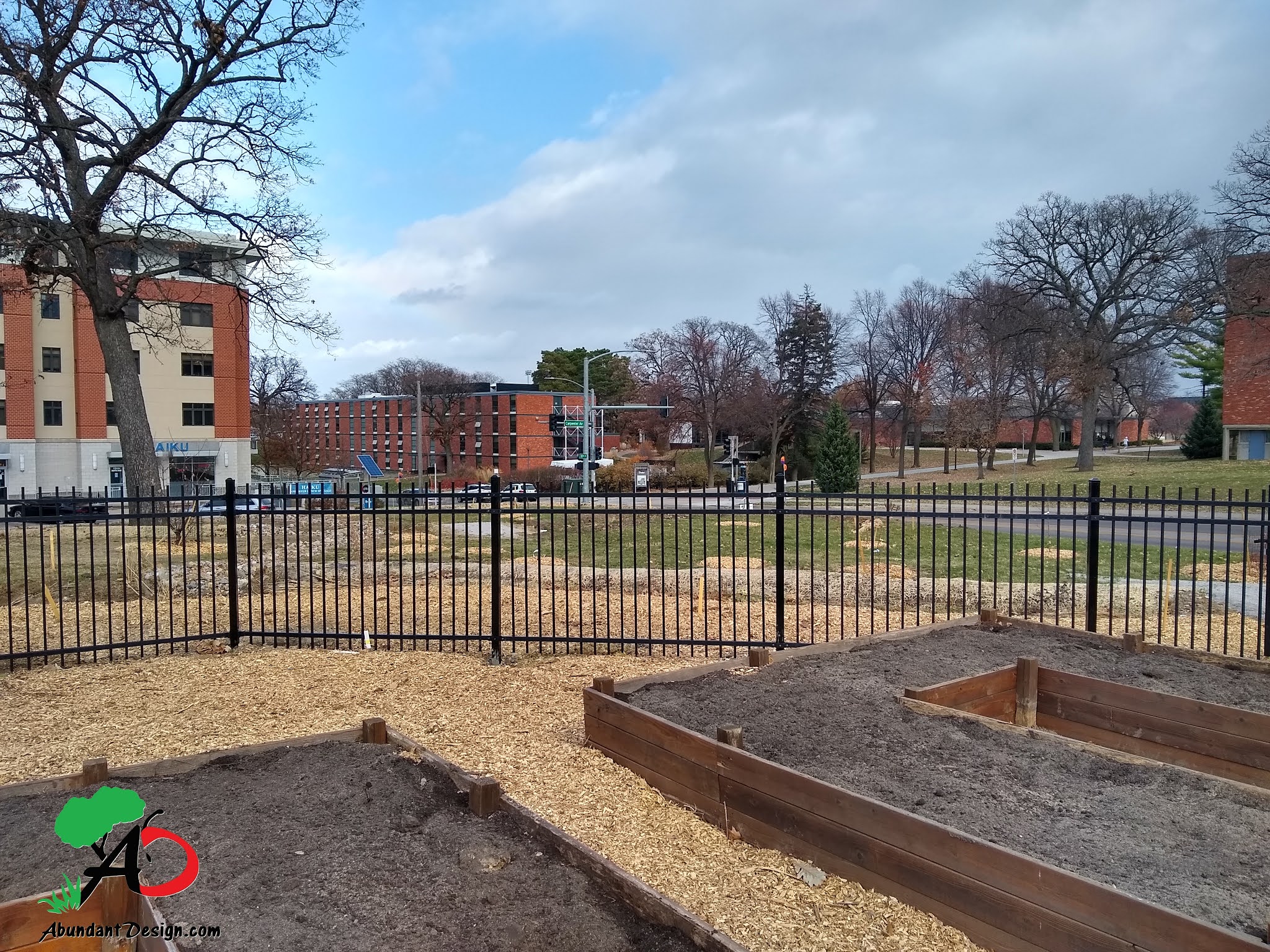
The Sprout Garden was originally located on Forest Avenue, near the Knapp Center and Boys & Girls Club, but due to new development the Sprout Garden had to be relocated. The new location at 30th & Carpenter is a prime location as the gateway to campus. The move also offered an opportunity for a redesign and introducing new features. Through word of mouth and our previous work at DMACC, Abundant Design was selected for the project.
Meetings were virtual, budgets and timelines were tight. Permits & getting approvals pushed back the start date, and approaching winter could put a hard stop on the installation. Trying to reuse and bring over from the existing location as possible we took inventory of what we could salvage. Ideas and possibilities were discussed among potential interested parties, with the current open space redesigned through several rough drafts into a food forest park, with permaculture tree guilds, runoff capturing rain gardens and gathering spaces.Work began with new site prep, grading and rainwater catchment to hydrate the parched lot and manage stormwater.
![]() |
| Site assessment and beginning dirt work |
![]() |
| Snow and rain helped confirm soil infiltration rates after construction |
![]() |
| Final overflow - three rain gardens double as On Contour Swales |
The garden shed was next, along with the rain barrel, and a new gathering/presentation space. Almost stadium style bench seating was built with the limestone brought over. The existing gingko trees from the green space were moved into the parkway for street trees requirement. This conserved budget and gave us lower growing trees as not to shade the garden production areas.
The Drake facilities team members were great to work with, and getting the shed and arbors moved.
Garden beds were modified from the previous rectangular beds (seen above) to keyhole beds using the aged but mostly reclaimed lumber. These keyholes allow for easier access to the plantings while increasing overall growing area, all with a smaller overall footprint.
![]() |
| Keyhole raised bed construction |
Wood cores will give them an almost hügelkultur effect, feeding beneficial fungi and helping to retain/wick moisture.
![]() |
| Aged wood lined beds and fungal activity |
At the end of Season one had the garden space moved and a great start on the mainframe of the forest garden park.
![]() |
| Arbor entry into the gardening area |
![]() |
| Raised beds, in-ground grow space, fence with orchard behind |
![]() |
| Teaching space with limestone benches off shed |